HARDLOCK Nut in Railway Lines: Reliable Fastening for Track Circuits and Impedance Bonds
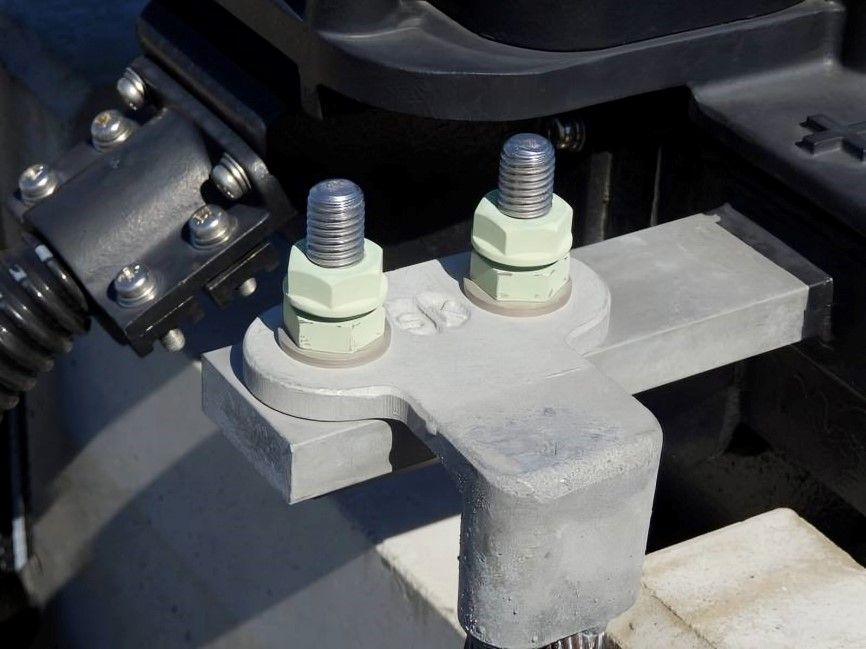
An impedance bond is critical in railway signalling because it ensures electrical isolation of track circuits from other electrical systems. This isolation allows signals to flow correctly, preventing interference or false signalling. The cable terminal securely connects cables to the impedance bond and track, establishing reliable electrical continuity.
These joints face both static loads—from the weight of thick power cables—and dynamic loads from train-induced vibrations and wind. Compounding the problem, cable terminals typically have short grip lengths (the combined thickness of clamped materials, excluding washers and nuts), making them especially prone to loosening.
If loosening occurs, the consequences can be severe:
- Increased Electrical Resistance and Overheating: Loose connections create higher resistance, generating heat that can damage insulation, degrade cables, and pose fire or short-circuit risks.
- Disruption of Track Circuit and Signal Integrity: Loss of continuity at the cable terminal can compromise the track circuit, causing intermittent or failed signals. This may trigger false train detection or missed train presence, impacting safety systems like Automatic Train Control (ATC) and Automatic Train Protection (ATP), and significantly increasing the risk of unsafe conditions.
To prevent these issues, HARDLOCK® nuts have been used since 2000 to secure impedance bond terminals across both high-speed and conventional rail networks in Japan. The solution has also been adopted in Taiwan’s high-speed rail, ensuring stable electrical continuity and reliable signal transmission.
Introduction
Modern railway infrastructure requires maximum reliability, safety, and minimal maintenance. One of the most critical challenges is bolt loosening caused by vibration, dynamic loads, and thermal cycling.
In railway lines, this issue directly affects not only mechanical components but also signaling systems, including impedance bonds, which are essential for proper track circuit operation.
HARDLOCK® nuts provide a proven anti-loosening solution used worldwide in railway infrastructure.
Why Bolt Loosening Is a Critical Problem in Railway Lines
Railway systems operate under extreme conditions:
- Continuous vibration from train movement
- Dynamic forces (acceleration, braking, curves)
- Temperature changes and thermal expansion
- Long-term cyclic loading
These factors lead to loss of preload in bolted joints, which can result in:
- Increased maintenance costs
- Reduced system reliability
- Safety risks in signaling and infrastructure
Traditional solutions (nylon nuts, adhesives) often fail under these conditions.
What Is an Impedance Bond and Why It Matters
An impedance bond is a key component in railway signaling systems.
It serves two main purposes:
- Allows traction return current to pass through the rails
- Separates signaling current used by track circuits
In electrified railways, impedance bonds ensure:
- Proper train detection
- Signal integrity
- Protection against interference from traction current
Technically, an impedance bond acts as a combined electrical and magnetic device, forming part of both the traction current loop and the signaling transmission system.
Because of its critical role, any loose connection can lead to overheating, signal failure, or incorrect train detection.
The Challenge: Fastening in Impedance Bond Installations
Impedance bonds are installed in environments exposed to:
- Strong vibration from passing trains
- Electrical load variations
- Outdoor conditions (temperature, humidity)
Loose fasteners in these systems can cause:
- Increased electrical resistance
- Heat generation
- Signal malfunction or failure
This makes reliable fastening absolutely critical.
HARDLOCK Nut Solution in Railway Lines
HARDLOCK® nuts use a mechanical wedge-locking principle that prevents loosening even under extreme vibration.
Key Features
- ✔ No loosening under vibration and shock
- ✔ Maintains preload long-term
- ✔ Reusable without performance loss
- ✔ No need for adhesives or special tools
Unlike conventional nuts, HARDLOCK® creates zero clearance between threads, ensuring a secure and stable connection.
Applications in Railway Infrastructure
HARDLOCK® nuts are used in multiple railway applications:
1. Track Systems and Rail Fastening
- Rail joints
- Turnouts and crossings
- Structural connections
2. Signaling Equipment (Including Impedance Bonds)
- Track circuits
- Electrical connections
- Control systems
3. Rolling Stock and Mechanical Systems
- Bogies and suspension
- Brake systems
- Structural components
These applications require long-term reliability without re-tightening, which HARDLOCK® provides.
Benefits for Railway Operators
Using HARDLOCK® nuts in railway lines delivers:
- Reduced maintenance and inspection frequency
- Increased safety and system reliability
- Lower lifecycle costs
- Elimination of bolt loosening failures
Railway networks worldwide have adopted this solution to improve operational efficiency and safety.
Conclusion
In railway infrastructure, especially in critical systems like impedance bonds, fastening reliability is essential.
HARDLOCK® nuts provide a maintenance-free, vibration-resistant solution that ensures:
- Stable electrical and mechanical connections
- Long-term performance
- Safe railway operation
For modern railway systems, they represent a proven standard in anti-loosening technology.