HARDLOCK® Nuts for Solar Panels: Preventing Loosening in Critical Installations
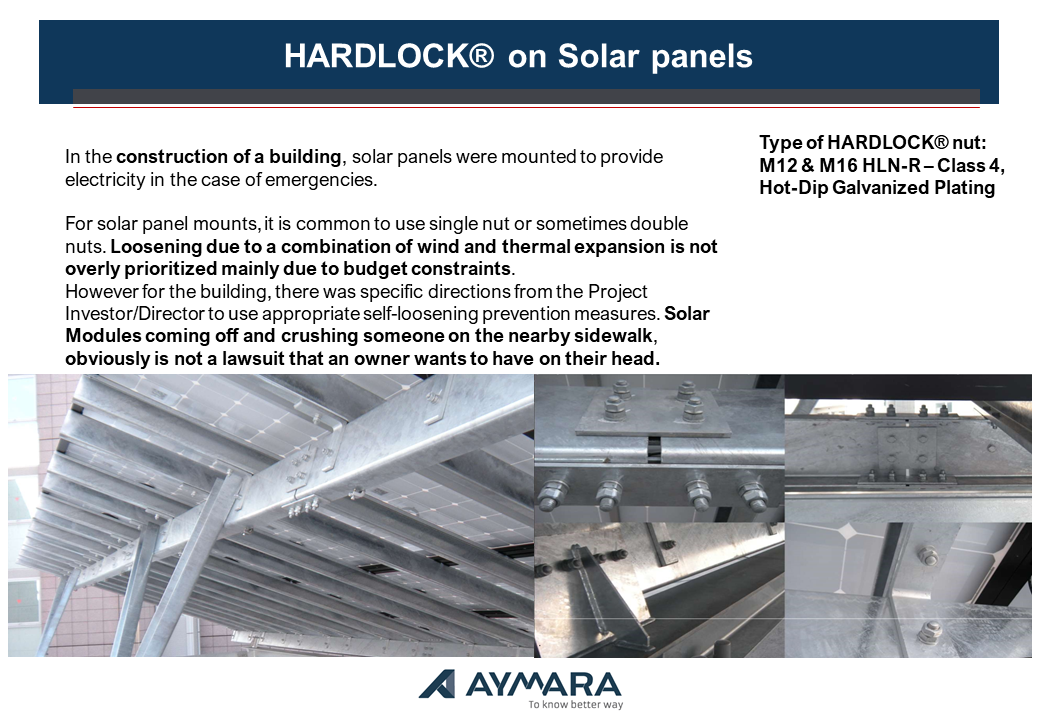
Why Fastener Security Matters in Solar Panel Systems
Solar panel installations are often perceived as low-maintenance systems. However, the reality is that bolted joints in solar structures are exposed to multiple forces that can cause gradual loosening over time.
Without proper anti-loosening solutions, even small fastener failures can lead to serious safety risks, structural instability, or costly maintenance.
Key Risk Factors That Cause Bolt Loosening in Solar Panels
1. Vertical and Elevated Installations
Solar panels mounted vertically or at an angle are constantly subjected to gravity and dynamic loads. These forces can gradually reduce bolt preload and lead to loosening.
2. Rooftop Installations
Panels installed on rooftops—such as schools, commercial buildings, and public infrastructure—face additional challenges, including wind uplift and structural vibrations.
3. Wind-Induced Vibrations
Strong winds generate both drag and lift forces, creating micro-movements in the structure. These vibrations are a major cause of fastener loosening in solar mounting systems.
4. Temperature Fluctuations
Daily and seasonal temperature changes cause thermal expansion and contraction, which directly affects bolt tension. Over time, this cycling leads to a loss of clamping force.
The Limitations of Conventional Locking Methods
Many installations rely on pal nuts (DIN 7967) or similar low-cost solutions to prevent loosening. While affordable, these methods often fail under real-world conditions involving vibration and temperature variation.
Common drawbacks include:
- Reduced effectiveness under dynamic loads
- Dependence on friction rather than mechanical locking
- Higher risk of long-term failure
HARDLOCK® Nut: A Reliable Anti-Loosening Solution
The HARDLOCK® nut system offers a mechanical locking mechanism that ensures long-term stability even in demanding environments.
How It Works
The system uses two specially designed components:
- A convex nut with an eccentric surface
- A concave nut that locks against it
When tightened together, these elements create a wedge effect, generating a strong perpendicular force that prevents rotation and loosening.
Advantages of Using HARDLOCK® Nuts in Solar Applications
✔ Superior Resistance to Vibration
Maintains secure fastening even under continuous wind-induced movement and structural vibration.
✔ Stability Under Thermal Cycling
Retains clamping force despite expansion and contraction caused by temperature changes.
✔ Reduced Maintenance Requirements
Minimizes the need for inspections and re-tightening, lowering operational costs.
✔ Enhanced Safety
Prevents accidental detachment of solar panels, especially in elevated or public installations.
✔ Reusability and Durability
Made entirely of metal, allowing repeated use without significant performance loss.
Typical Use Cases in Solar Installations
HARDLOCK® nuts are particularly effective in:
- Rooftop solar arrays
- Ground-mounted solar farms
- High-wind or extreme climate regions
- Public or safety-critical infrastructure
These are environments where fastener failure is not an option.
Conclusion
Solar panel systems operate in conditions that naturally promote bolt loosening—vibration, wind loads, and thermal expansion. Standard locking methods often fall short in these environments.
By using a mechanical wedge-locking principle, HARDLOCK® nuts provide a long-term, maintenance-free solution that enhances both safety and reliability in solar installations. English and Polish version).