Safety is Power, The Worlds Strongest Self-locking Nut!Safety Is Power: The World’s Strongest Self-Locking NutSafety is Power, The Worlds Strongest Self-locking Nut!
In modern engineering, fastener reliability is not optional—it is critical. From heavy industrial machinery to high-precision equipment, even a small failure in a bolted joint can lead to catastrophic consequences. One of the most common causes of such failures is loosening due to vibration and external forces.
To solve this problem, advanced fastening solutions like the HARDLOCK® self-locking nut have been developed—offering unmatched safety, durability, and performance even in the most demanding environments.
Why Do Bolted Joints Fail?
The primary reason bolted joints fail is the loss of initial clamping force (preload). This usually happens because of:
- Continuous vibration
- Impact forces
- Thermal expansion and contraction
- Dynamic loads
When preload decreases, even slightly, a gap forms between threads. This leads to progressive loosening, reduced lifespan, and eventually bolt failure or structural damage.
In critical industries, such failures can result in costly downtime—or worse, safety hazards.
The Engineering Breakthrough: HARDLOCK® Nut
The HARDLOCK® nut is designed to eliminate thread play entirely, ensuring a secure and permanent fastening solution. Unlike traditional nuts, it uses a unique wedging principle that creates a powerful locking force.
Key advantages include:
- Extreme anti-loosening capability
- Consistent performance under vibration
- Long-term durability without degradation
- No need for special tools or additional components
According to engineering analysis, its locking performance can be up to 1000× stronger than standard hex nuts, reaching a level comparable to welding, adhesives, or riveted joints.
Proven Performance in Extreme Conditions
The HARDLOCK® nut has been tested under some of the harshest conditions, including:
- Cryogenic temperatures down to −196°C
- High-load stress environments
- Severe vibration testing (Junker test)
Results show:
- No loosening or rotation
- No thread damage or fracture
- No galling on contact surfaces
This makes it suitable for advanced applications such as fusion reactors, heavy industry, and critical infrastructure.
Why Traditional Self-Locking Nuts Fall Short
Many conventional locking nuts—such as nylon insert types—have limitations:
- They degrade over time
- They struggle with high temperatures or coatings
- They require higher tightening force
- They may crack under external stress
In contrast, HARDLOCK® nuts are all-metal, meaning they do not deteriorate and maintain consistent performance even in harsh environments.
Real-World Applications
HARDLOCK® technology is widely used across industries where safety and reliability are essential:
- Industrial pumps and rotating equipment
- Construction and infrastructure projects
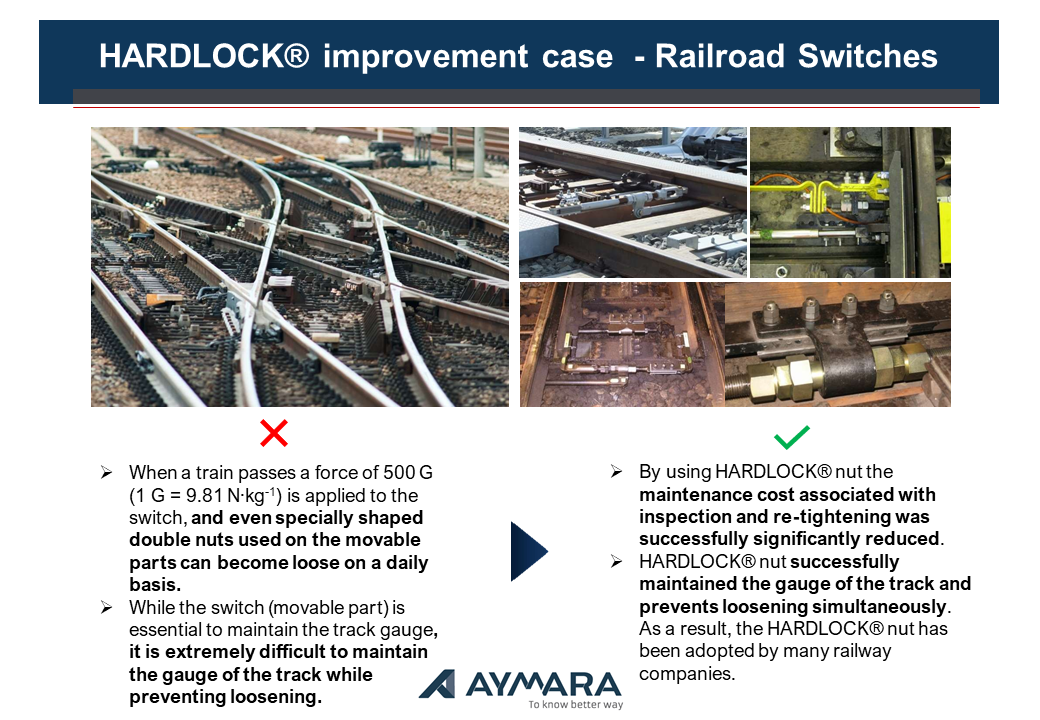
- Railway and transportation systems
- Energy sector (including nuclear and renewables)
For example, in pump systems exposed to strong vibrations, maintaining preload is critical to avoid fatigue failure and costly repairs. HARDLOCK® nuts ensure joints remain tight and stable over time.
Cost Efficiency Through Reliability
While high-performance fasteners may seem like a premium solution, they actually reduce total costs by:
- Minimizing maintenance
- Preventing equipment failure
- Eliminating downtime
- Extending service life
In demanding environments, investing in reliable fastening solutions is not just about safety—it’s about long-term operational efficiency.
Conclusion
In industries where failure is not an option, the choice of fastening technology matters. The HARDLOCK® self-locking nut represents a next-generation solution that combines strength, durability, and safety.
By eliminating loosening—even under extreme vibration and environmental conditions—it provides engineers with confidence, reliability, and peace of mind.