Enhancing Fastener Reliability in Power Plants with HARDLOCK®
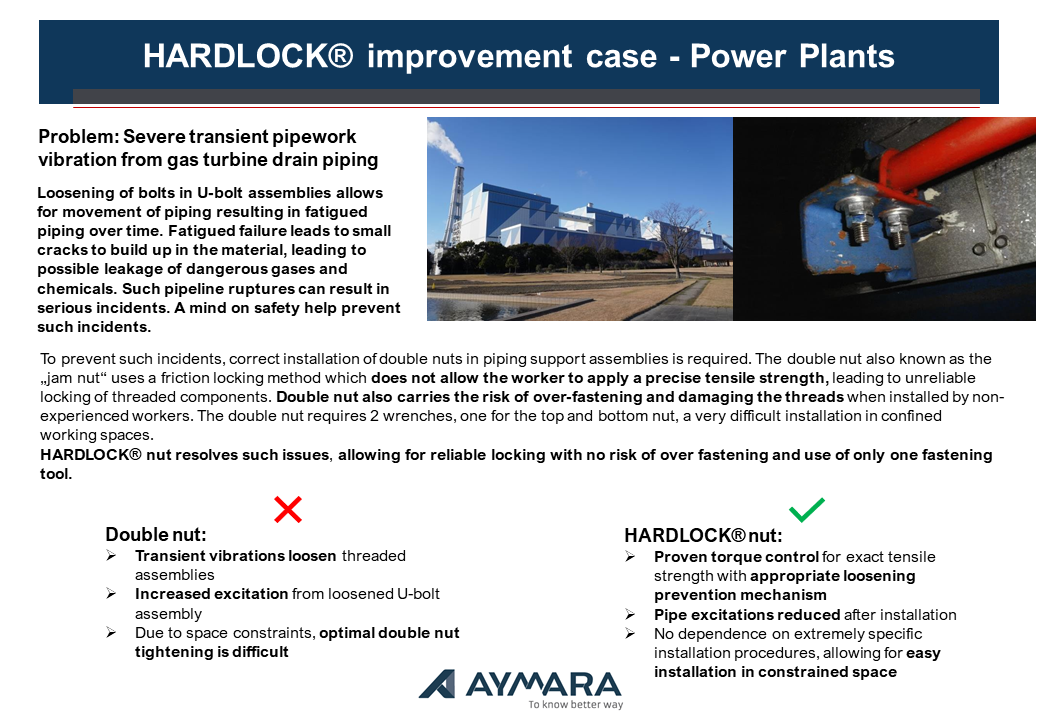
Power plants operate under extreme conditions where safety, reliability, and uninterrupted performance are critical. From thermal and nuclear facilities to renewable energy systems, bolted joints are constantly exposed to vibration, thermal expansion, and long-term mechanical stress. Even minor loosening can result in serious consequences, including equipment failure, leakage, or costly downtime.
This case study explains how HARDLOCK® technology improves fastening reliability and reduces maintenance demands in power plant environments.
The Challenge: Bolt Loosening in Harsh Energy Environments
Power generation systems create a combination of conditions that accelerate fastener loosening:
1. Continuous Vibration
Equipment such as turbines, pumps, and compressors generates persistent vibration. Additionally, fluid movement in pipelines introduces dynamic forces that can gradually loosen conventional fasteners.
2. Thermal Expansion and Temperature Cycling
High operating temperatures and repeated heating/cooling cycles cause materials to expand and contract. This leads to loss of preload and instability in bolted joints.
3. Long-Term Mechanical Stress and Fatigue
Cyclic loading and stress concentration weaken joints over time. Once preload is lost, fatigue accelerates, increasing the risk of cracks or leaks in critical systems.
4. High Maintenance Pressure
Frequent loosening forces operators to perform repeated inspections and retightening, increasing operational costs and risking unplanned shutdowns.
Real-World Problem: Conventional Double-Nut Fastening
In many power plants, double-nut systems are traditionally used for securing critical components such as:
- Pipeline supports (U-bolts)
- Structural frameworks
- Reactor core supports
- Equipment anchoring systems
However, these systems often fail under real operating conditions:
- Loosening occurs regularly due to vibration and thermal expansion
- Maintenance crews must perform frequent retightening
- Large facilities require extensive labor and high maintenance costs
The Solution: HARDLOCK® Self-Locking Technology
HARDLOCK® nuts use a mechanical wedge-locking principle that eliminates loosening even under extreme conditions. Unlike traditional solutions that rely on friction, HARDLOCK® creates a secure lock through a combination of convex and concave nuts.
How It Works
- Two nuts create an eccentric locking mechanism
- Radial force eliminates thread clearance
- Rotation is mechanically prevented
This design ensures stable preload even under:
- Strong vibration
- Thermal expansion and contraction
- Long-term cyclic loading
Improvement Results in Power Plant Applications
After replacing conventional fastening systems with HARDLOCK® nuts, significant improvements were achieved:
✔ Elimination of Loosening
Fasteners remained secure despite vibration and temperature fluctuations.
✔ Reduced Maintenance Requirements
The need for frequent retightening was dramatically minimized, saving both time and labor costs.
✔ Increased Operational Safety
Stable fastening reduced risks associated with pipeline movement, structural instability, and potential leaks.
✔ Lower Total Operating Costs
Reduced maintenance interventions and downtime led to substantial cost savings over time.
Key Applications in Power Plants
HARDLOCK® nuts are widely used in critical areas such as:
- Pipeline support systems
- Turbine and generator assemblies
- Pumps and rotating machinery
- Structural steel frameworks
- Renewable energy installations (wind, solar)
These are environments where fastener failure is not acceptable.
Why Preload Stability Matters
Maintaining proper preload is essential for:
- Preventing pipe movement and misalignment
- Ensuring even load distribution
- Minimizing vibration amplification
Loss of preload can lead to:
- Increased stress and fatigue
- Structural damage
- System failure
HARDLOCK® technology directly addresses these risks by maintaining consistent clamping force over time.
Comparison with Traditional Fastening Methods
Conventional solutions (e.g., double nuts, nylon lock nuts) rely on friction or material deformation, which degrade over time.
In contrast, HARDLOCK® provides a mechanical locking system that remains effective regardless of environmental conditions, ensuring long-term reliability without frequent maintenance.
Conclusion
Power plants demand fastening solutions that can withstand extreme vibration, thermal stress, and long-term loading. Conventional methods often fall short, leading to increased maintenance and safety risks.
HARDLOCK® nuts offer a proven solution by preventing loosening, maintaining preload, and significantly reducing maintenance requirements. The result is improved safety, enhanced reliability, and lower operational costs across critical energy infrastructure.