HARDLOCK® Nuts in High-Speed Trains: A Proven Solution for Safety and Maintenance Efficiency
Introduction
In the world of high-speed rail, safety, reliability, and maintenance efficiency are critical. Modern trains operate under extreme conditions—high speeds, continuous vibration, and demanding operational schedules. Traditional fastening methods, such as welding, have proven to be inefficient over time.
A more advanced solution has emerged: the HARDLOCK® self-locking nut system, which has transformed fastening technology in high-speed trains.
The Challenge of Traditional Fastening Methods
Before the 1990s, components mounted under high-speed trains were typically secured by welding. While effective initially, this method presented significant drawbacks:
- Difficult and time-consuming maintenance
- Limited accessibility for repairs
- Increased downtime after long-term operation
After approximately 1.2 million kilometers of travel (around 1.5–2 years), maintenance became increasingly complex and inefficient.
Transition to HARDLOCK® Nuts in High-Speed Rail
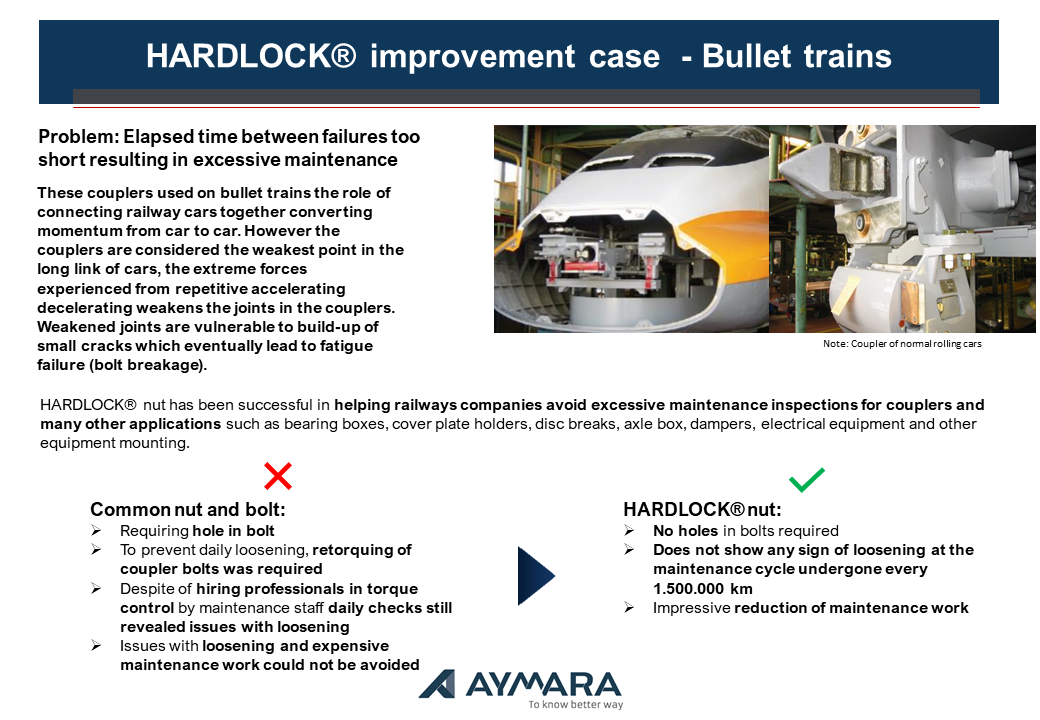
With the introduction of newer train models in the early 1990s, railway engineers adopted HARDLOCK® nuts as an alternative fastening solution.
Instead of permanent welding, mechanical fastening using HARDLOCK® nuts allowed:
- Easy removal and reinstallation of components
- Faster maintenance cycles
- Improved operational efficiency
This shift marked a major advancement in railway engineering.
How HARDLOCK® Technology Works
HARDLOCK® nuts use a dual-nut wedge locking mechanism, consisting of:
- A convex nut with an eccentric protrusion
- A concave nut with a matching recess
When tightened together, these nuts create a powerful lateral locking force that:
- Prevents loosening due to vibration
- Resists impact and dynamic loads
- Maintains consistent clamping force
This mechanical locking principle ensures long-term reliability even in extreme conditions.
Proven Performance in Bullet Trains
HARDLOCK® nuts have been widely implemented in high-speed rail systems, including Japanese bullet trains.
Key results include:
- Used in all Shinkansen models since the 300 Series (introduced in 1992)
- Approximately 20,000 HARDLOCK® nut sets per train
- Zero reported failures since adoption
This track record demonstrates exceptional reliability in one of the most demanding transportation environments.
Key Benefits for High-Speed Train Applications
1. Absolute Resistance to Loosening
The wedge-locking mechanism eliminates gaps between threads, ensuring stability even under continuous vibration and shock.
2. Maintenance Reduction
Unlike welded joints, HARDLOCK® nuts allow quick disassembly, significantly reducing maintenance time and costs.
3. Reusability
Made entirely of metal, these nuts can be reused multiple times without losing performance.
4. Cost Efficiency
Lower maintenance requirements and reduced downtime result in long-term cost savings.
5. Enhanced Safety
With zero failure cases in high-speed rail applications, HARDLOCK® nuts provide a fail-safe fastening solution.
Why HARDLOCK® Nuts Are Ideal for High-Speed Rail
High-speed trains require fastening systems that can withstand:
- Constant vibration
- High dynamic loads
- Frequent maintenance cycles
- Strict safety standards
HARDLOCK® nuts meet all these requirements, making them a preferred choice in railway engineering worldwide.
Conclusion
The adoption of HARDLOCK® nuts in high-speed trains represents a major evolution in fastening technology. By replacing traditional welding methods, they offer superior safety, reliability, and maintenance efficiency.
With decades of proven performance and zero failure records in critical applications, HARDLOCK® nuts continue to set the standard for secure fastening in high-speed rail systems.