Safety Is Power: The World’s Strongest Self-Locking Nut
IIntroduction
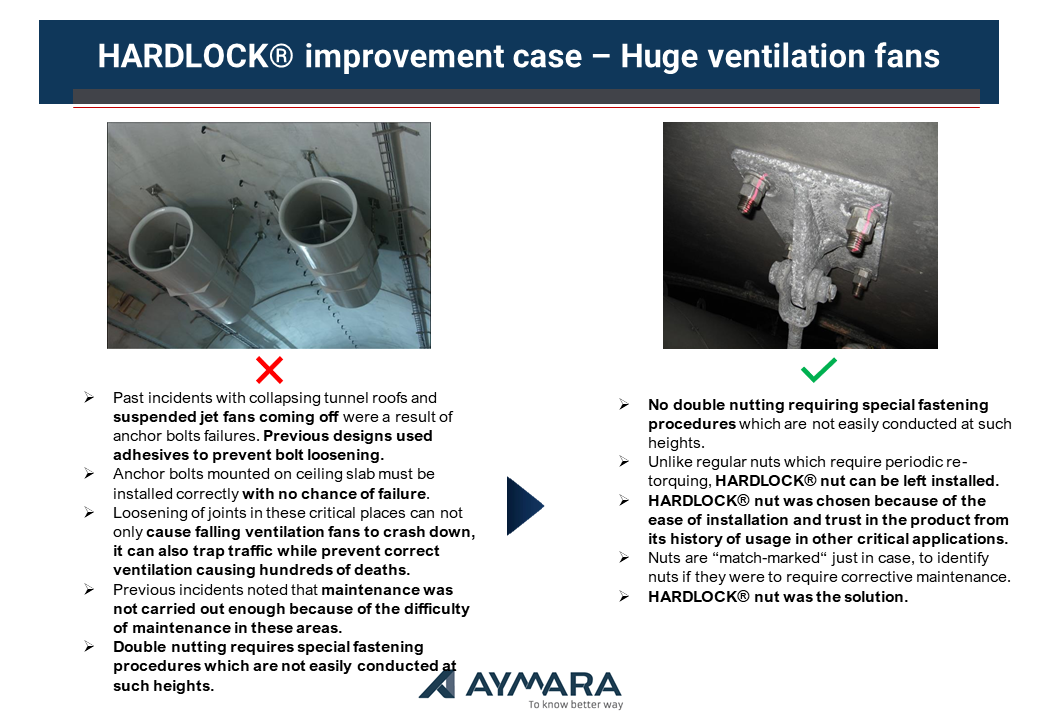
In industrial environments where safety and reliability are critical, even a minor failure in fastening systems can lead to serious consequences. One such case involves anchor bolts used to suspend ventilation fans—components identified as a significant safety risk due to their location and operating conditions.
This case study highlights how modern self-locking technology, specifically the HARDLOCK® nut, addresses these challenges effectively.
The Problem: Loosening in Critical Applications
Anchor bolts supporting ventilation systems are often installed in hard-to-reach locations. While correct installation is essential, ongoing maintenance becomes difficult or even impractical due to limited accessibility.
Previously used anti-loosening solutions failed to prevent bolt loosening, which ultimately led to joint failure. This created a need for a more reliable fastening method that does not rely on frequent inspections or maintenance.
Why Bolted Joints Fail
The primary cause of loosening in bolted joints is the loss of initial clamp load. External forces such as vibration and impact gradually reduce this force, allowing movement between threads.
This movement can lead to:
- Reduced joint lifespan
- Bolt fatigue and breakage
- Increased risk of catastrophic failure
Traditional fastening systems often cannot eliminate the internal clearance between threads, which is a key factor in loosening.
The Solution: HARDLOCK® Nut Technology
The HARDLOCK® nut introduces a fundamentally different approach to fastening. Its unique design eliminates thread clearance and provides a powerful self-locking effect.
Key Benefits:
- Exceptional loosening resistance even under extreme vibration
- Reliable performance in critical joints
- No need for periodic retightening
- Easy installation using standard tools
Unlike conventional nuts, the HARDLOCK® system achieves a locking effect up to 1,000 times stronger than standard hex nuts, comparable to welding or adhesive bonding.
Design Advantages
The HARDLOCK® nut consists of a dual-nut mechanism that creates a strong mechanical lock without relying solely on preload. This ensures that even if some preload is lost, the joint remains secure.
Additional advantages include:
- Reusability without significant performance loss
- Compatibility with various materials and coatings
- No requirement for special tools or components
Improved Maintenance Strategy
Modern engineering increasingly favors solutions that minimize maintenance requirements. In this case, the use of a “match-mark” allows easy visual inspection, while the HARDLOCK® nut eliminates the need for frequent corrective maintenance altogether.
This leads to:
- Reduced downtime
- Lower maintenance costs
- Increased operational safety
Conclusion
For applications where safety cannot be compromised, such as suspended ventilation systems, choosing the right fastening solution is critical. The HARDLOCK® nut provides a proven, maintenance-free solution that ensures long-term reliability even in the most demanding environments.
By eliminating loosening and simplifying installation, it represents a significant advancement in industrial fastening technology.