Safety is Power, The Worlds Strongest Self-locking Nut!Safety Is Power: The Ultimate Self-Locking Nut for Critical ApplicationsSafety is Power, The Worlds Strongest Self-locking Nut!
Introduction
In industries where safety, reliability, and long-term performance are non-negotiable, even the smallest component can make a significant difference. One such innovation is the HARDLOCK® self-locking nut—engineered to eliminate loosening and ensure maximum joint integrity under extreme conditions.
Why Traditional Fastening Methods Fail
Bolted joints are widely used across engineering applications, but they are inherently vulnerable to loosening. This typically occurs due to:
- Vibrations and dynamic loads
- Thermal expansion and contraction
- External impacts or cyclic stress
When the initial clamping force drops, gaps form between threads, leading to fatigue, reduced lifespan, and potential structural failure.
The HARDLOCK® Solution: A New Standard in Fastening Technology
The HARDLOCK® nut introduces a powerful mechanical locking system based on the wedge principle, inspired by traditional Japanese engineering.
How It Works
The system consists of two components:
- A convex nut with an off-center protrusion
- A concave nut with a matching conical recess
When tightened together, these elements create a strong lateral force that locks the bolt in place, eliminating any internal play. This ensures that the connection remains secure—even under intense vibration or shock.
Key Advantages
1. Exceptional Anti-Loosening Performance
The HARDLOCK® nut delivers a self-locking effect significantly stronger than conventional nuts—comparable to welded or bonded joints.
2. Proven Reliability in Extreme Conditions
Testing has shown:
- No loosening under cryogenic temperatures (down to -196°C)
- No thread damage or fracture under load
- No surface galling after vibration testing
3. Reusability and Cost Efficiency
Unlike many locking solutions, HARDLOCK® nuts can be reused without losing performance, reducing maintenance costs over time.
4. Easy Installation
They require no special tools or additional components, making them practical for a wide range of applications.
Real-World Applications
High-Speed Rail (Shinkansen)
Before 1992, underfloor components on Japanese bullet trains were welded, making maintenance difficult after extended use.
With the introduction of HARDLOCK® nuts:
- Welding was replaced with mechanical fastening
- Maintenance became faster and more efficient
- Approximately 20,000 nuts are used per train set
- Zero failures have been reported since adoption
Renewable Energy (Solar Installations)
Solar panel systems are exposed to continuous wind loads, which can gradually loosen standard fasteners. HARDLOCK® nuts prevent this issue by maintaining joint integrity, even in hard-to-access mounting systems.
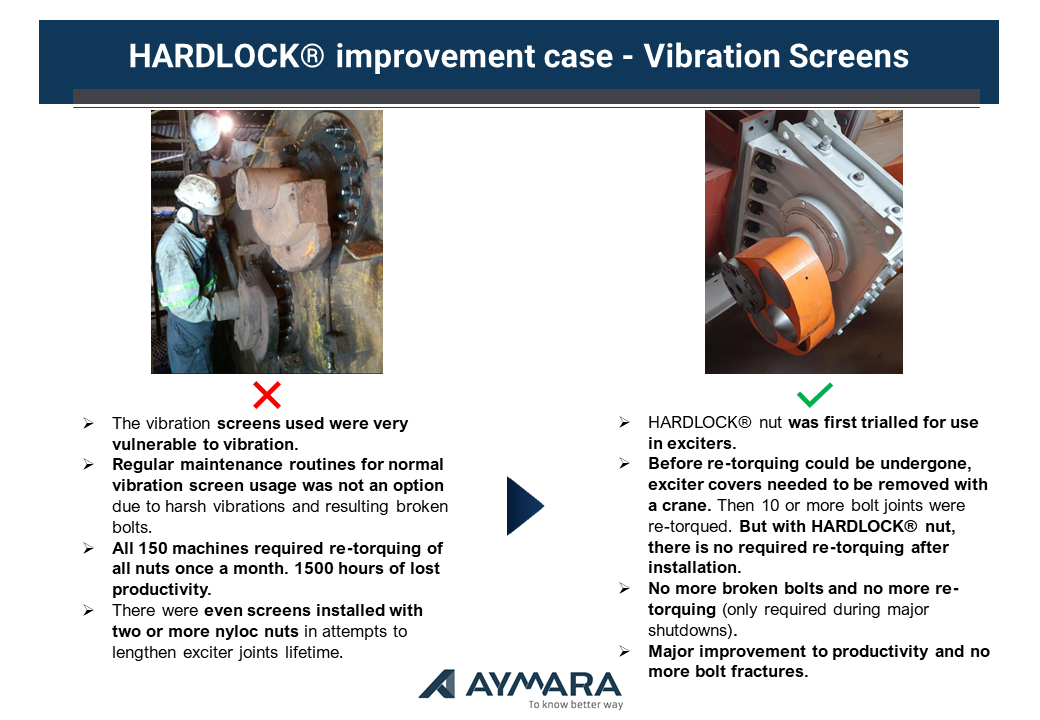
Heavy Industry and Steel Mills
In high-temperature environments, constant expansion and contraction can reduce friction and cause conventional nuts to loosen. HARDLOCK® nuts eliminate this risk by maintaining a secure lock without slipping.
Infrastructure and Construction
From bridges and highways to skyscrapers and machinery, HARDLOCK® nuts are used in critical structures where failure is not an option.
Long-Term Durability and Safety
The reliability of HARDLOCK® technology is backed by decades of real-world use. For example:
- Used in Shinkansen trains since 1992 with no reported failures
- Applied in structures requiring up to 100-year lifespan durability
This track record makes it one of the most trusted fastening solutions globally.
Conclusion
When it comes to safety-critical applications, conventional fastening methods often fall short under real-world conditions. HARDLOCK® self-locking nuts provide a superior alternative by eliminating loosening, reducing maintenance, and ensuring long-term reliability.
Whether used in transportation, energy, construction, or heavy industry, this innovative fastening solution represents a major advancement in engineering safety.